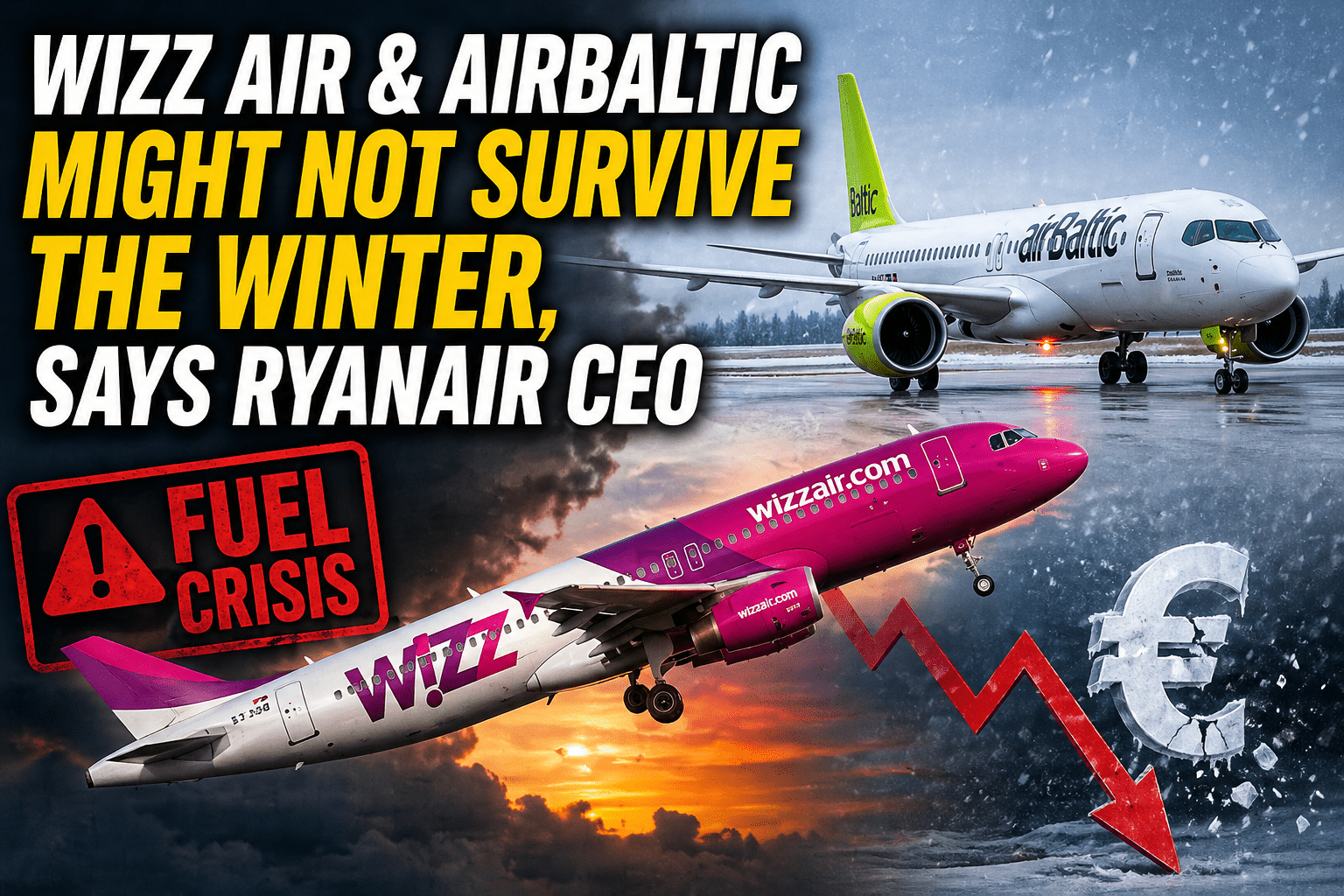
Europe’s aviation industry could be heading into a turbulent winter, at least according to Ryanair’s outspoken CEO, Michael O’Leary. In a recent warning, he suggested that some low-cost airlines may not survive the coming months if fuel prices remain at current levels.
Among those he singled out were Wizz Air and airBaltic—two well-known carriers that, in his view, could struggle to stay afloat as operating costs continue to rise.
Rising Fuel Costs Putting Pressure on Airlines
The global fuel situation has become increasingly unstable, driven largely by geopolitical tensions in the Middle East. Concerns over supply disruptions—particularly around key shipping routes—have pushed oil prices sharply higher.
For airlines, this is a major problem. Fuel is one of their biggest expenses, and sudden spikes can quickly erode profits. While some carriers protect themselves through fuel hedging, not all are equally covered.
Ryanair, for example, secured a large portion of its fuel at lower prices earlier on. However, even it is now feeling the impact, with millions already added to its fuel bill. For airlines less protected, the situation is even more serious.
Why Some Airlines Could Be at Risk
According to O’Leary, carriers that didn’t lock in fuel prices ahead of the surge may find themselves in a difficult position. Buying fuel at current market rates—more than double previous levels in some cases—can rapidly drain cash reserves.
This is where his warning becomes more direct. He believes that if prices stay high, some airlines could run out of money before the winter season ends. In particular, he pointed to Wizz Air and airBaltic as potentially vulnerable.
His comments were blunt, even by his usual standards, suggesting that a shake-up in the industry could ultimately reduce competition.
Not Everyone Agrees
Unsurprisingly, Wizz Air has pushed back against these claims. The airline insists it remains financially stable, highlighting strong liquidity and long-term planning as key strengths. According to the company, it has enough resources to continue operating well into the future, even under challenging conditions.
airBaltic’s situation appears more complex. While the airline has modernized its fleet and continues to operate across Europe, it has faced financial pressure recently. Credit ratings have been downgraded, and it has relied on government support to stay stable in the short term.
A Wider Industry Problem
The challenges go beyond just two airlines. Across Europe, carriers are dealing with rising costs, volatile fuel markets, and uncertain demand.
Ticket prices have already started to increase as airlines attempt to offset higher expenses. At the same time, some regions are more exposed than others when it comes to fuel supply, adding another layer of risk.
The United Kingdom, for instance, has been highlighted as particularly vulnerable due to its reliance on specific fuel import routes.
What Happens Next?
The coming months will be critical. If fuel prices stabilize, airlines may be able to adapt and recover. But if the situation worsens, the industry could see significant disruption.
For passengers, this could mean higher fares, fewer routes, and less competition. For airlines, it’s a test of financial resilience and strategic planning.
As always with O’Leary’s predictions, not everyone will agree—but his warning does highlight a very real issue. The aviation sector is once again facing uncertainty, and this time, the pressure is coming from the fuel tanks.