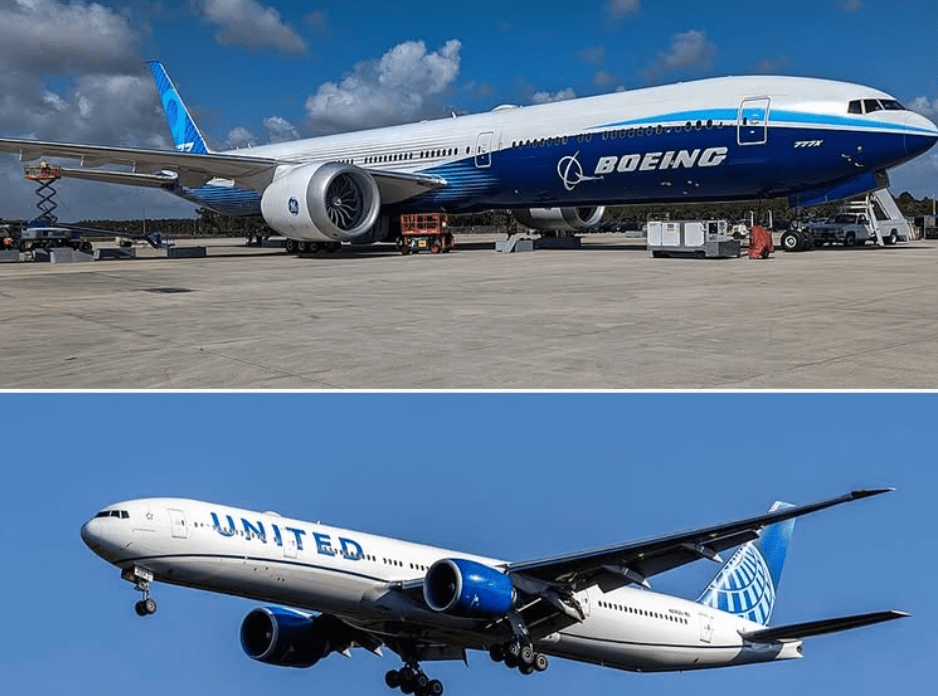
The Boeing 777X doesn’t just stretch the 777-300ER—it completely rewrites the economics of long-haul flying. Here’s why airlines are betting on fuel efficiency over raw range, and what the GE9X engines, folding wingtips, and composite wings actually mean for your next flight.
The Range Paradox: Less Can Actually Be More
At first glance, the numbers look almost too close to call. The Boeing 777-300ER punches out roughly 7,370 nautical miles on a full tank. Its bigger sibling, the 777-9? Just 7,285 nautical miles.
Wait—shorter range on a next-gen aircraft?
Here’s the thing Boeing never tried to hide: the 777X was never a range chase. It was a profit chase. Boeing built this jet to haul more passengers, burn dramatically less fuel, and turn the same long-haul routes into cash machines for airlines. The range drop is intentional engineering, not a compromise.
Where the Real Magic Happens: 10–15% Fuel Efficiency Jump
The GE9X—The Most Advanced Jet Engine Ever Built
The heart of the 777X’s transformation is the GE9X, a powerplant so advanced it holds the world record for thrust at 134,300 lbf during testing. But raw power isn’t the headline—efficiency is.
Compared to the GE90-115B engines on the 777-300ER, the GE9X delivers:
- 10% lower specific fuel consumption
- 60:1 overall pressure ratio (up from 40:1 on the GE90)
- 10:1 bypass ratio for quieter, cooler, more efficient thrust
- 16 composite fan blades—six fewer than the GE90, yet more airflow and less drag
GE packed this engine with ceramic matrix composites (CMCs)—materials that run 500°F hotter than metal while weighing a third as much and needing 59% less cooling air. The result? An engine that produces half the NOx of anything in its class and meets noise standards with room to spare.

The Folding Wingtip Revolution
The 777X’s 71.8-meter wingspan (235 ft 5 in) is massive—too massive for most airport gates. Boeing’s solution? Folding wingtips that tuck up to shrink the span to 64.8 meters (212 ft 9 in) on the ground.
This isn’t a gimmick. It lets the 777X squeeze into Code E airport infrastructure—the same gates the 777-300ER uses—while unlocking a higher aspect ratio wing in flight. That longer, slimmer wing generates more lift with less drag, directly feeding into the 20% lower fuel burn and emissions Boeing claims versus the aircraft it replaces.
Composite Everything
Boeing didn’t just bolt new engines onto an old frame. The 777X borrows heavily from the 787 Dreamliner playbook:
- All-new carbon fiber composite wing
- Lighter materials throughout the structure
- Advanced flight controls and high-lift design
The wing alone is a generational leap. It’s curved like the 787’s—optimized for laminar flow and reduced induced drag—while the composite construction cuts weight without sacrificing strength.
Two Completely Different Philosophies
| 777-300ER Era | 777X Era |
|---|---|
| Raw thrust dominated design | Aerodynamic efficiency dominates |
| Fuel burn was acceptable | Fuel burn is the enemy |
| Bigger engines = better | Smarter engines = better |
| Range at any cost | Profit per seat, per mile |
The 777-300ER was a beast of its time—reliable, powerful, and a workhorse for two decades. The 777X? It’s a financial instrument with wings. Boeing didn’t build it to outrun the -300ER. They built it to out-earn it.
What This Means for Airlines (and Passengers)
For airlines, the math is brutal and beautiful:
- 10% lower operating costs than the competition
- More seats per flight without needing more fuel
- Lower emissions = easier compliance with tightening environmental regulations
- Reduced noise footprint = access to stricter airports
For passengers? Quieter cabins, potentially lower fares on competitive routes, and the comfort of flying on an aircraft designed around efficiency rather than brute force.
Bottom Line
The Boeing 777X vs 777-300ER debate isn’t about which plane flies farther. It’s about which plane flies smarter. With the GE9X, folding wingtips, and a composite wing philosophy borrowed from the 787, the 777X represents a fundamental shift in how Boeing thinks about long-haul economics.
Range is a number. Profit per nautical mile is the real metric—and that’s where the 777X was built to dominate.